How to Accessorize Renaissance Dresses for Authentic Style
Renaissance style is one of those looks that can read as “time-travel convincing” or “costume aisle” with just a few small choices. The dress does a lot of heavy lifting, of course—but accessories are what signal who you are in that world: a merchant’s wife in Florence, a court attendee in England, a German townswoman on market day. The good news? You don’t need a museum budget to get the details right. You need a clear reference point, a few well-chosen pieces, and the discipline to avoid modern distractions.
Below is a practical, historically informed way to accessorize Renaissance dresses so the overall impression feels cohesive and authentic—whether you’re dressing for a faire, a photoshoot, or living-history events.
Start with the “where and when” before you shop
“Renaissance” covers a long stretch (roughly the 14th to early 17th century, depending on region), and accessories changed significantly over time and place. A French hood and a Venetian pearl earring can both be “Renaissance,” but they don’t belong to the same outfit.
Before you add anything, decide on two anchors:
Choose a region (even loosely)
English Tudor? Italian (Florentine/Venetian)? German lands? Spanish court influence? Even a broad choice helps you avoid mixing silhouettes and accessories that never shared the same streets.
Choose a social role
A noblewoman, artisan, tavern keeper, or scholar’s wife will wear different materials and amounts of ornament. Authenticity isn’t just “old-looking”—it’s appropriate.
Once you’ve got that, your accessory choices stop being random and start telling a story.
Build from the base layers: linen, lacing, and structure
A Renaissance outfit is fundamentally layered. Accessories sit differently when the underpinnings are right, and they can look oddly modern if the foundation is missing.
Don’t skip the chemise (shift)
A simple linen or linen-look chemise under your dress is one of the quickest authenticity upgrades. It frames the neckline, protects outer garments, and makes jewelry look period-correct because it sits on fabric rather than bare skin.
Use period-style closures where possible
Renaissance clothing often relied on:
- lacing (spiral or ladder lacing),
- ties,
- pins,
- hooks and eyes (later periods).
If your dress has a visible zipper, you can sometimes disguise it with a belt, a decorative placard, or layered outerwear. Better yet, choose garments designed with historical closure logic in mind. If you’re still selecting your main pieces, it helps to start with a thoughtfully designed renaissance-inspired clothing collection so the accessories you add won’t be fighting modern seams, shiny synthetics, or awkward hardware.
The most “Renaissance” accessory is actually your headwear
If you want the fastest path to looking authentically dressed, focus above the shoulders. In many Renaissance settings, a covered or styled head was the norm, especially for married women.
Veils, coifs, and caps: simple and effective
A white coif, linen cap, or light veil instantly places the look in a pre-modern context. It also gives you a secure base for pins, hair ribbons, or jeweled bands.
Hoods and more structured options
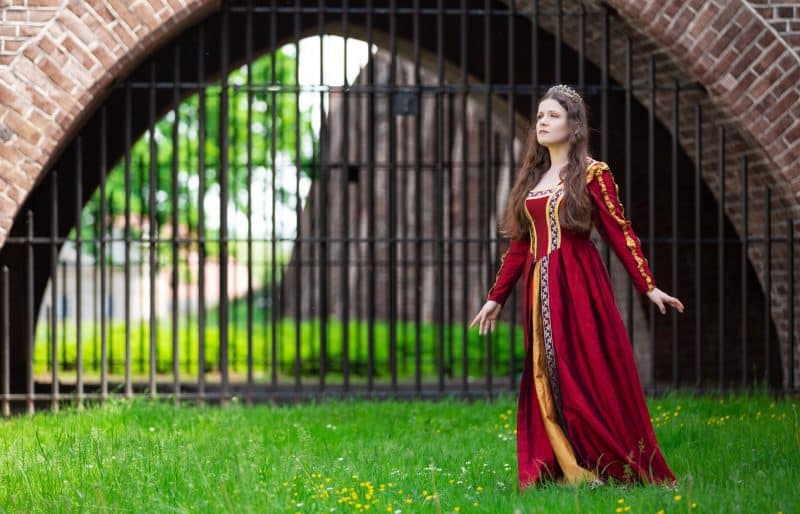
For an English-inspired look, variations of the hood (including gable and French styles) are iconic—though they require the right gown silhouette to truly work. For Italian-inspired outfits, consider netted hair coverings, delicate veils, or a jeweled circlet worn with a controlled hairstyle.
If you’re unsure, choose one headpiece and commit to it. One coherent choice reads more authentic than three competing focal points.
Jewelry: fewer pieces, better materials, stronger impact
Renaissance jewelry can be bold, but it’s rarely “sparkly in every direction.” Even when ornamented, it tends to look intentional and weighty.
Aim for a grounded palette
Think:
- pearls (real or convincing faux),
- amber tones,
- garnet or deep glass colors,
- gold-toned metals (muted rather than mirror-bright),
- enamel-like accents.
Avoid super-clear rhinestones and highly reflective chrome finishes unless you’re specifically emulating a stylized theatrical look.
Place pieces where portraits place them
The most believable Renaissance jewelry choices are often:
- a single pendant on a ribbon or chain,
- a short strand of pearls,
- modest drop earrings (region-dependent),
- a brooch used as a functional pin (for a shawl or partlet).
If your neckline is already ornate, let it breathe. One strong pendant beats multiple necklaces layered in modern fashion.
Belts, pouches, and the practicality test
A surprising number of “authentic-looking” outfits fall apart the moment you need pockets. The Renaissance solution was wearable storage—stylish and functional.
Choose the right belt width and placement
Many Renaissance looks use belts that sit at the natural waist or slightly lower, depending on the gown’s cut. Overly skinny modern belts can read contemporary. Look for leather or woven belts with simple buckles.
Add a pouch (and let it look used)
A small pouch, purse, or modest belt bag is period-friendly and solves real problems at events. The trick is to avoid modern shapes and logos. Soft leather, simple stitching, and a slightly slouchy form feel more believable than anything rigid and glossy.
Footwear and outer layers: the details people forget
Shoes and outerwear often determine whether your outfit looks “themed” or truly lived-in.
Shoes: prioritize shape over decoration
Renaissance footwear often has a rounded or slightly squared toe and a low profile. Avoid visible athletic soles, heavy platform wedges, or modern ankle boot silhouettes. If you must compromise for comfort, choose a plainer shoe and let the hemline do its work.
Cloaks, shawls, and partlets
A cloak or mantle can be transformative, especially in cooler weather. For modesty or added period texture, consider a partlet (a fabric piece that fills in the neckline) or a simple shawl pinned with a brooch.
A quick finishing checklist (without overthinking it)
If you want an outfit that reads authentic at a glance, check these three things before you walk out the door:
- One era + one region (no mix-and-match across centuries)
- One headwear choice (cap, veil, hood, or circlet—pick a lane)
- One hero accessory (pendant, belt+pouch, or cloak)
That’s it. If those three are coherent, the rest can be simple.
The real secret: restraint and consistency
The Renaissance aesthetic rewards consistency more than abundance. When every accessory looks like it belongs to the same person, in the same town, in the same year, the whole outfit clicks. Ask yourself: would someone in this setting wear this all at once? If the answer is “maybe not,” edit.
Choose a strong base, add headwear, pick one or two meaningful accessories, and let the materials—linen, leather, metal, glass—do the talking. Authentic style isn’t about looking expensive; it’s about looking plausible.