Enhancing Natural Light in Windowless Bathrooms
A windowless bathroom doesn’t have to feel like a cave. In fact, some of the brightest, most calming bathrooms I’ve seen were interior rooms with no exterior exposure at all. The trick is understanding what we’re really chasing when we say “natural light.”
It isn’t just brightness. It’s quality—soft, even illumination, minimal glare, good color rendering, and the sense that light is coming from a believable direction. When you design for those qualities, a windowless bath can feel open and restorative instead of flat and gloomy.
Below are the most effective ways to get there, from architectural moves to practical finishes you can implement in a weekend.
Start by “Borrowing” Light From Nearby Spaces
If you can’t bring daylight in from outside, your next best move is to bring it through the bathroom from an adjacent, brighter room. Designers call this “borrowed light,” and it’s often the highest-impact change because it introduces real daylight—not just a convincing imitation.
Use transoms, interior glazing, and frosted panels
Consider adding:
- A transom window above the door
- A frosted or reeded-glass panel beside the door (a sidelight)
- Interior glazing on a wall that adjoins a naturally lit hallway or bedroom
These options preserve privacy while allowing daylight to travel. Frosted, fluted, and sandblasted glass all diffuse light differently, so choose based on the mood you want: fluted glass creates a soft, directional glow; fully frosted glass is more uniform.
Know when to consider a tubular skylight
If the bathroom sits under an attic or roofline, a tubular daylight device (often called a solar tube) can be a game-changer. It channels sunlight from a small roof opening through a reflective tube into a ceiling diffuser. You won’t get sky views, but you will get real daylight at usable levels—especially midday.
Let Light Travel: Surfaces, Layout, and Visual Obstacles
Once light is available—borrowed or artificial—the next step is to help it move through the room without getting “caught” on dark finishes and opaque barriers.
Choose finishes that reflect, not swallow
High reflectance doesn’t have to mean “all white everything,” but it does mean being strategic:
- Light-toned paint with a wipeable satin or semi-gloss finish bounces more light than matte.
- Large-format tile reduces grout lines, which can visually “break up” light.
- Gloss or polished surfaces (used selectively) can lift brightness dramatically.
Think of your bathroom like a light box. If the walls and ceiling absorb illumination, you’ll need much more wattage to achieve the same perceived brightness.
Rethink the shower enclosure: glass matters
One of the most common daylight-killers in a windowless bathroom is a bulky visual block right in the middle of the room—typically a shower curtain or framed enclosure. Replacing that barrier with clearer sightlines can make a surprisingly big difference, even if your lighting doesn’t change.
If you’re evaluating glass options and want a straightforward reference point for styles and considerations, framelessshowerdoors.com is a useful resource to understand how different shower door designs affect openness, reflections, and overall light transmission. The broader takeaway is simple: the more continuous your lines of sight, the brighter the room feels.
Use mirrors as light tools, not just decor
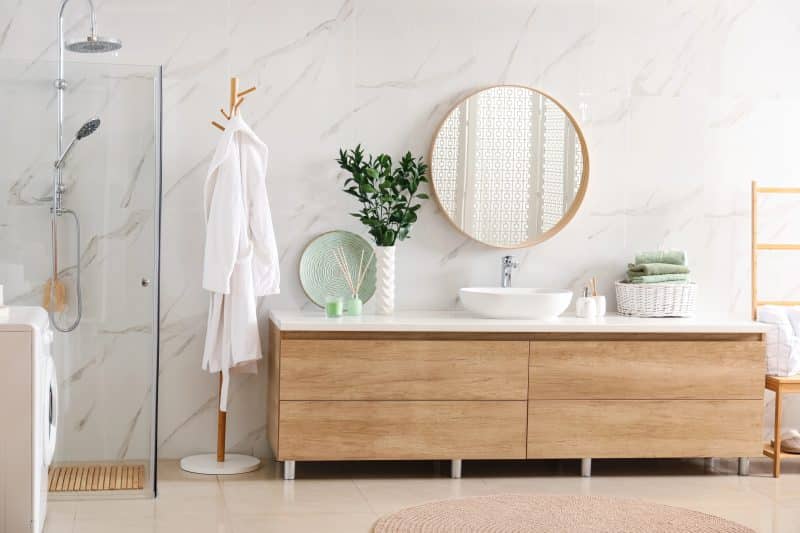
Mirrors don’t create light, but they multiply it. The best placements are the ones that reflect your brightest source—usually the vanity lighting or the door/transom area.
A few practical guidelines:
- Go larger than you think. A mirror that spans most of the vanity width spreads light more evenly across faces and walls.
- If you have borrowed light from a transom or sidelight, position a mirror so it “catches” that glow.
- Avoid placing a mirror where it reflects clutter or towel storage; visual noise makes spaces feel dimmer.
Upgrade Artificial Lighting So It Feels Like Daylight
In windowless rooms, artificial lighting isn’t a backup plan—it is the plan. The goal is not to flood the room with harsh brightness, but to create layered, believable illumination.
Get the color temperature and CRI right
If your bathroom lighting feels gray or jaundiced, check two specs:
- Color temperature (Kelvin): For most bathrooms, 3000K–3500K hits a warm-but-clean sweet spot. If you want a crisp, spa-like look, 3500K–4000K can work well, especially with cooler tiles.
- CRI (Color Rendering Index): Aim for 90+ CRI. It’s the difference between skin tones looking healthy versus slightly “off,” and it helps finishes look richer.
Layer your light: ambient, task, and accent
A single ceiling fixture creates shadows under eyes and chins and leaves corners murky. Better results come from layers:
- Ambient: Recessed downlights or a ceiling fixture that fills the room.
- Task: Vanity lights at face level—ideally sconces on both sides of the mirror or a well-designed horizontal fixture above it.
- Accent: A toe-kick LED under the vanity or a niche light in the shower for depth.
Dimmers are worth it here. In a windowless space, being able to tune intensity throughout the day keeps the room from feeling either stark or sleepy.
Pick fixtures that control glare
Clear glass shades and exposed bulbs can create sparkle, but they can also cause uncomfortable glare—especially against mirrors and glossy tile. Diffused lenses, frosted globes, and well-aimed recessed trims give you brightness without the “interrogation room” effect.
Add Depth: Contrast, Texture, and Smart Color Choices
“Bright” doesn’t have to mean “flat.” In fact, a bathroom that’s uniformly pale can feel washed out even when it’s well lit. Depth is what makes light feel natural.
Use contrast intentionally
A soft contrast—like a warm white wall with a slightly darker vanity—adds definition, which helps the eye read the room as more dimensional. Texture plays a similar role: a honed stone, fluted cabinet fronts, or subtly patterned tile can create gentle shadowing that mimics what daylight does in real spaces.
Don’t forget the ceiling
Windowless bathrooms often have a lower perceived ceiling height because light doesn’t naturally graze across it. Painting the ceiling a clean, light color (sometimes even a half-step lighter than the walls) helps bounce illumination down into the room.
Keep It Bright Over Time: Moisture, Maintenance, and Real-World Use
Even the best lighting plan gets undermined by foggy mirrors, mineral deposits, and yellowing caulk lines.
- Use a quality exhaust fan (sized properly for the room) to reduce haze and protect finishes.
- Choose grout and caulk colors that won’t visually “dirty” the room as they age.
- Clean glass and mirrors regularly; film buildup can noticeably cut reflectance.
A windowless bathroom can absolutely feel bright and natural—you just have to treat light like a material. Borrow what you can, let it travel, shape it with surfaces, and refine it with high-quality, well-layered fixtures. Do that, and the room stops feeling like an interior compromise and starts feeling intentionally designed.